Ossipee Watershed residents get LakeSmart to help prevent cyanobacteria blooms
By Tara Schroeder
Education Coordinator
At GMCG we always say “water knows no boundaries” because the water quality of our lakes, ponds, rivers and streams is determined by what flows into it from the surrounding landscape or watershed. Water does not obey town or state lines as it flows from the headwaters in the mountains to our lakes and ponds. As our watersheds become more developed and the frequency and intensity of storm events continue to increase due to climate change, water is picking up more nutrients and contaminants across the landscape, and they are finding their way into our surface waters. According to NH LAKES, polluted runoff causes over 90% of the water quality problems in New Hampshire’s lakes and rivers.
For the past twenty years GMCG has been addressing stormwater runoff and nonpoint source pollution through education and best management practices (BMPs) projects on lakes such as Berry Bay, Ossipee Lake, Broad Bay, Leavitt Bay, Province Lake and Danforth Ponds. On August 5, GMCG hosted Kat Kelleher, Conservation Program Coordinator for NH LAKES, who shared techniques and tips for making properties lake-friendly to protect water quality. “I am so excited that in the LakeSmart Program we get to share with homeowners tailored recommendations to stop run-off and protect the waterbodies we love”, said Kelleher. They are worried about cyanobacteria and the future of our state’s waterbodies. “It’s exciting to share with homeowners solutions and options they did not know were available to make their homes work for their lives and the lake!”
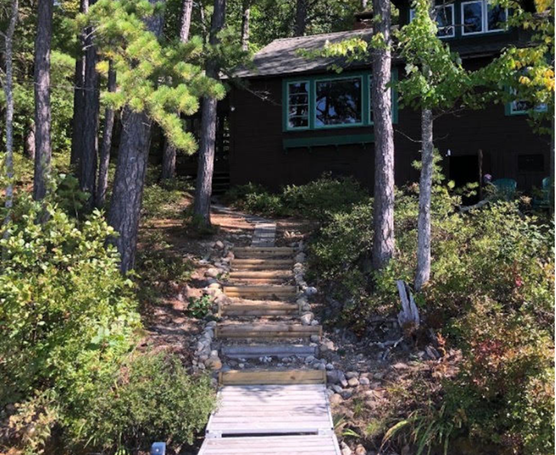
Infiltration steps on a waterbody in the Ossipee Watershed that were put in as part of the LakeSmart program to reduce stormwater runoff and erosion of the shoreline. (Photo courtesy Kat Kelleher, NH LAKES).
Kelleher’s presentation focused on the need for prevention with BMPs to cool, slow and capture water in the soil and keep nutrients and other pollutants from entering waterbodies. Some of her tips included: leaving native vegetation, woody plants and trees for shade and infiltration (a fully grown tree can take upwards of 30-40 gallons of water per day!); maintaining vegetative buffers especially in the protected shoreland, naturalizing lawns or mowing less, and keeping pine needles and leaves as
nature’s mulch; infiltrating water with vegetation, dry creek beds, stone or rain gardens, infiltration steps, pathways, walkways and trenches; and diverting water with rain barrels, waterbars, rubber razors, fire hose diverters and other techniques.
“Small changes have large impacts,” she exclaimed. And, don’t forget to maintain your septic system, pick up after your pets and avoiding fertilizers and other pollutants like salt which can also be toxic to aquatic organisms and harmful to humans. Property owners should also be aware of the Shoreland Protection Act and its restrictions on the use of fertilizers along the shoreline. No fertilizer, except limestone, may be used within 25 feet of the reference line (shoreline). Beyond that distance, NHDES recommends either avoiding fertilizer or using fertilizer without phosphorus and not to exceed label application rates.*
There are a number of helpful resources available for property owners, landscapers, businesses, lake association and other community members. The LakeSmart program is one that is taking off in the Ossipee Watershed with ambassadors from the Ossipee Lake System and Silver Lake, as well as other waterbodies. In this free, voluntary, and nonregulatory program of NH LAKES, a qualified professional will come out to your property and talk through ways you could better protect lake health with the decisions you make on your property. Homeowners whose actions protect lake health are recognized with a LakeSmart award.
To date, participation in the program includes: Ossipee Lake with 24 properties, Silver Lake in Madison with 31 properties, and Big Pea Porridge Pond in Madison with 12 properties. Kelleher shared that NH LAKES has also had 10 tours on Conway Lake, 1 on Bearcamp Pond in Tamworth and 6 on Duncan Lake in Ossipee, but that these waterbodies do not have a LakeSmart Community (or ambassadors) at this time. Visit nhlakes.org/lakesmart for more information and their Resource Library for actions homeowners can take.