Ossipee Watershed residents step up for salamanders
by Tara Schroeder
GMCG Education Coordinator
“Big Nights” happen in early spring, when thousands of frogs, toads, and salamanders cross roads from upland, forested areas to wetlands where they breed. During salamander brigades, volunteers help amphibians cross roads safely while collecting data on species diversity and abundance. This information helps identify important habitat and migration “hot spots” across the landscape.
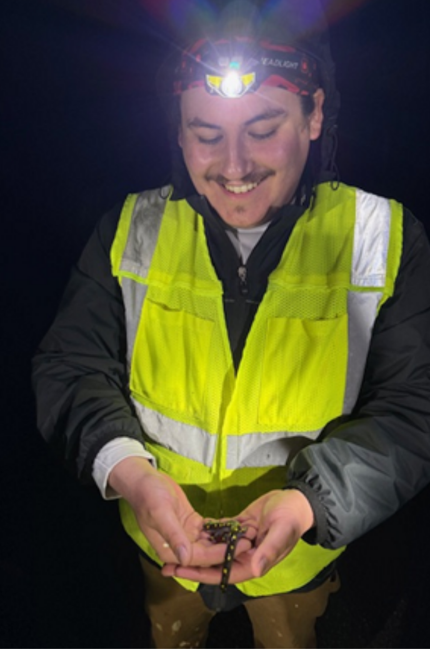
Volunteer Lucas Kirsch helps a spotted salamander across the road. (Photo by Tara Schroeder)
GMCG and Chocorua Lake Conservancy have hosted salamander brigades in Tamworth for the past two years. We have also collaborated with Tin Mountain Conservation Center and The Harris Center for Conservation Education to launch this participatory science program in our part of the state, recruit volunteers, and raise awareness about the importance of amphibian migrations and habitat conservation.
The Harris Center has been leading salamander brigades for 20 years, and in 2026 reached the milestone of helping more than 100,000 amphibians cross roads safely.
Meanwhile, plans are underway for New Hampshire’s first amphibian tunnels at a crossing on Jordan Road in Keene. The site was chosen because of the presence of Jefferson complex salamanders, a Species of Greatest Conservation Need (SGCN), as well as the many years of community science data collected there. NH Fish and Game, the City of Keene, and the Harris Center are partnering on the project, which is supported by grant funding from the National Fish and Wildlife Foundation’s America’s Ecosystem Restoration Initiative.
Science Director Brett Amy Thelen shared: “The Harris Center’s Crossing Brigade program has played an integral role in several on-the-ground amphibian conservation measures in Keene, including the protection of amphibian habitat adjacent to one of our busiest crossing sites, the implementation of New Hampshire’s first Big Night road closures, and — now — the Granite State’s very first amphibian tunnels. Our volunteers not only provided data to inform these conservation efforts (for instance, documenting the presence of an at-risk species at one crossing site, and of a high volume of amphibians at another), but also demonstrated that there was strong community support for these kinds of wildlife conservation initiatives. Both were essential to the success of these projects.” Sandwich Takes the Lead
Here in the Ossipee Watershed the Sandwich Conservation Commission (SCC) began organizing its own salamander brigades and using iNaturalist to document amphibians and crossing sites that can be shared with the public.
“We are assembling salamander brigades each spring to collect data, observe trends, and document important wildlife areas in town going forward, and help amphibians cross paved roads,” says Nancy Walser, chair of the Sandwich Conservation Commission.
The SCC launched its brigades in 2025 as a pilot program. Four commissioners started small, getting a feel for what was involved while scouting for active crossing sites.
In February, wetland scientist and commissioner Dr. Rick Van de Poll gave a “science talk” on vernal pools that drew 40 people. Van de Poll was part of the early monitoring efforts in the 1990s, when he conducted the Robin Hood Park Natural Resource Inventory for the City of Keene.
“I documented Jefferson’s salamander, which was/is a SGCN. We noted many getting killed on Jordan Road, so started to help them get across on rainy nights.”
Since then, Van de Poll has surveyed dozens of sites, including 34 sites monitored regularly in Sandwich since 2004. “I’d have to tally how many critters I’ve helped across, but it is certainly in the hundreds.”
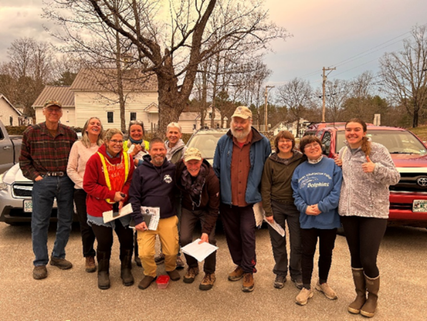
Sandwich Conservation Commission members and community volunteers help with salamander brigades this spring. (Photo courtesy Nancy Walser)
“Van de Poll sees the brigades as an effective way to connect conservation work with the broader community.
“We’ve gotten the police aware of ‘Big Nights,’ as well as a number of townsfolk, many of whom have come out to volunteer their time. It’s a great project for the conservation commission as it is very visible, has a positive effect on local amphibian populations, and is consistent with our mission as a municipal organization.”
Following Van de Poll’s talk, the SCC started a text chain to alert people when weather conditions looked right for a migration. Fourteen volunteers came out on the first night. The commission also posted information about amphibian migrations on the town’s listserv and asked residents to avoid driving on the first rainy nights when temperatures were above 50 degrees.
“Afterwards, I got A LOT of questions about the brigades—what we saw, etc. There has been high interest even among people who didn’t take part in the nighttime counts,” says Nancy.
Raising Awareness and Protecting Habitat
The brigades are about more than helping individual amphibians cross the road. For the SCC, they are also a way to raise awareness about biodiversity, habitat loss, and the importance of protecting places such as vernal pools.
“Our goals are to raise awareness about the importance of amphibians to biodiversity, how some are endangered due to habitat loss, pollutants and climate change. We also want to raise awareness about the special places in our town that they depend on such as vernal pools. The development pressure in Sandwich means that we need to raise awareness about protecting important natural resources; thoughtful land use, in other words,” says Walser.
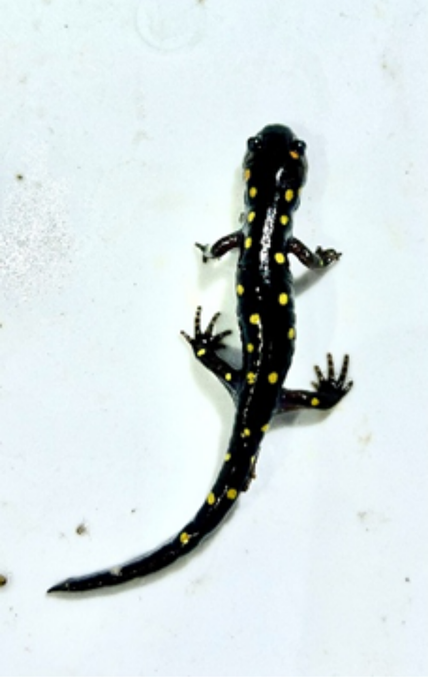
Spotted salamanders can live up to 30 years and spend most of their lives underground. Each one has its own unique spot pattern, like human fingerprints. (Photo Eden Beauchesne)
The commission has also incorporated these conservation priorities into the town’s broader planning efforts. “We have also participated in the updating of the Sandwich master plan’s Natural Resources chapter this year. A survey of about 700 residents was conducted for the master plan, and ‘protecting natural resources’ was cited by respondents as the top challenge for the town’s future. So we’ve spent some time thinking about goals and initiatives to do that; protecting vernal pools is one of those,” said Walser.
he brigades have also produced some exciting discoveries. Walser notes that volunteers were particularly excited to document a leopard frog in Sandwich, one of three frog species identified as being of greatest conservation need in New Hampshire.
Getting Started
For conservation commissions interested in starting their own salamander brigades, Walser points to the wealth of resources available through the Harris Center.
“The resources on the Harris Center website are amazing. We asked all volunteers to take the online training, and we used their data collection sheet out in the field to count the numbers of amphibians that we found. We also use the iNaturalist app to do identifications and document the different species found with photos.”
One of the commission’s members created an iNaturalist project page for the 2026 season. Walser compiled the written field reports into a narrative describing what volunteers found and plans to share it on the Conservation Commission webpage.
“We’ll post it on our Conservation Commission webpage and advertise that because so many people asked about what we found. We are also sending the data to GMCG to track what is found in the region.”
Van de Poll agrees that collaboration and local knowledge are key to making these efforts successful. “There are now lots of good example towns to seek advice from, as well as the Harris Center that really put crossing guard efforts on the map. It really helps to have someone or several people who have been informally keeping track of good crossing areas to advise the volunteers who wish to go out. It is also helpful to have an organization like GMCG who is willing to tally regional results, as this amps up the effectiveness of the effort.”
A Growing Regional Effort
This year, salamander brigades in Sandwich, Tamworth, Bartlett, and Conway brought together 46 volunteers who helped 389 amphibians cross roads safely to their breeding grounds.
To learn more about salamander brigade programs, visit harriscenter.org. To find out how you can help with a local brigade, contact education@gmcg.org.
There are other ways to help, too: stay off the roads during critical spring migration nights, contribute to participatory science, and share amphibian observations through platforms such as iNaturalist or the Reptile and Amphibian Reporting Program (RAARP), coordinated by the NH Fish and Game Department.
For conservation commissions considering starting their own brigades, Nancy offers several pieces of advice:
- Start small. Begin without volunteers so that you understand what is involved before taking on a larger effort.
- Ask residents to stay off the roads on Big Nights. Let people know that avoiding driving during these critical migration events is one of the most important ways they can help.
- Communicate with your police chief in advance. Our police chief received several calls about slow-moving cars and people walking along roads with headlamps. Once they were told about the brigades, everyone was supportive.
- Share your findings. Write up what you discover so people in town can learn about the results and stay engaged with the project.
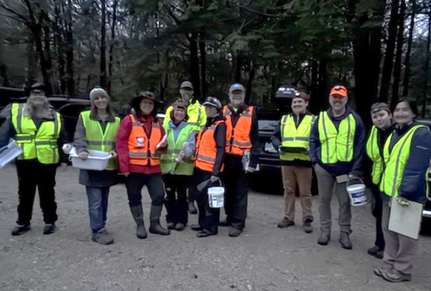
GMCG and CLC volunteers are ready for the 2026 salamander brigade following an educational program in Tamworth. (Photo courtesy of Sue Kelly)
Organizations such as GMCG, Chocorua Lake Conservancy, and Tin Mountain Conservation Center can help support these efforts, too. Van de Poll believes that coordinating efforts across communities can help build local involvement.
“Coordinating efforts across each of their member towns can help stimulate more and more local involvement. Continuing to offer training workshops, helping aggregate count data, and posting results in several media outlets will all help get the word out and hopefully reduce traffic flow during critical times of year.”
For Van de Poll, one of the most exciting examples of what can grow from years of community science and local involvement is the Jordan Road project in Keene.
“Perhaps the most exciting is watching the development of the Jordan Road, Keene story over the years to the point where we are actually getting the very first amphibian underpass in the state built at this site!”
It will be interesting to see the impacts of the underpass in Keene on amphibians in the coming years, and hopefully it is the first of many efforts to ensure safe passage for amphibians across the region.